Artébay, November 23: Doris Salcedo, Rita Lundqvist, Angela Heisch
A house woven from human hair on Madison Avenue, small Swedish fables in Chelsea, and a London opening where geometry goes soft.

Doris Salcedo, a House Woven From Hair
Doris Salcedo, White Cube New York, through February 6, 2027
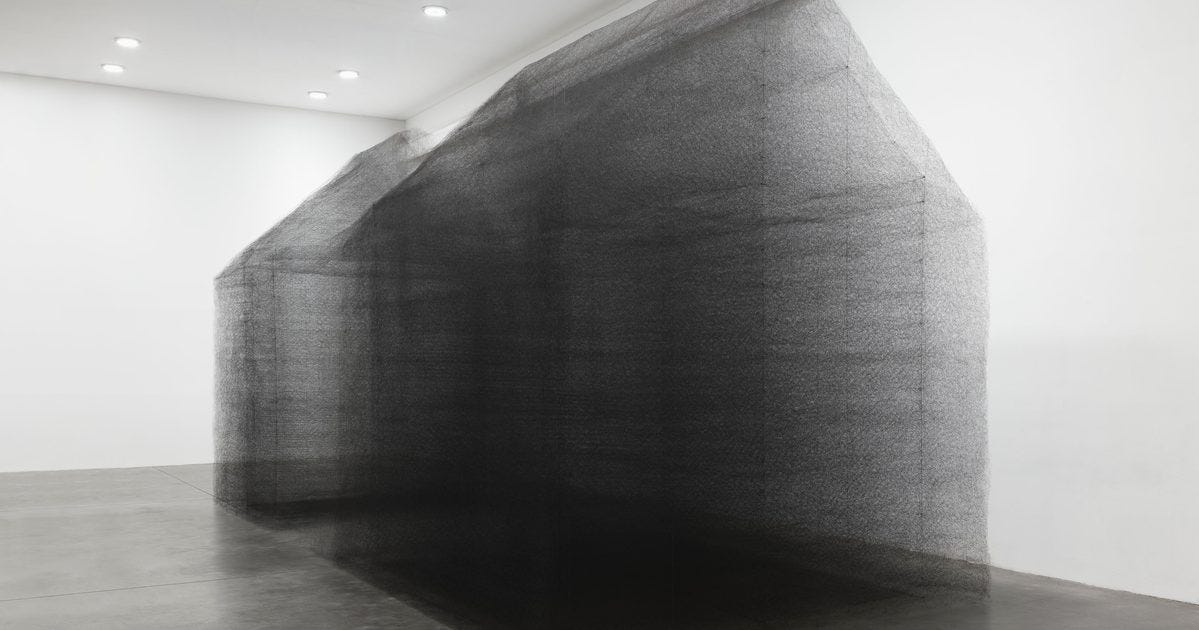
At the center of White Cube’s gallery on Madison Avenue stands a house you can see through. Its walls and pitched roof are charcoal dark and as thin as gauze, and the white room shows faintly behind them. The whole structure is woven from human hair.
Doris Salcedo and her studio in Bogotá spent three years making it. The title is the word House with a line struck through it, and the work is dated 2023-26. According to the gallery, the hair is woven together with stainless steel thread stained to match its color and width, and the form is held at its corners by steel wires one millimeter thick. The first plan was to build the inner part from hair alone. It would not stand, so the steel was added. Andreas Huyssen, a professor emeritus at Columbia University who visited the studio, writes of several false starts and of tools invented for the job.
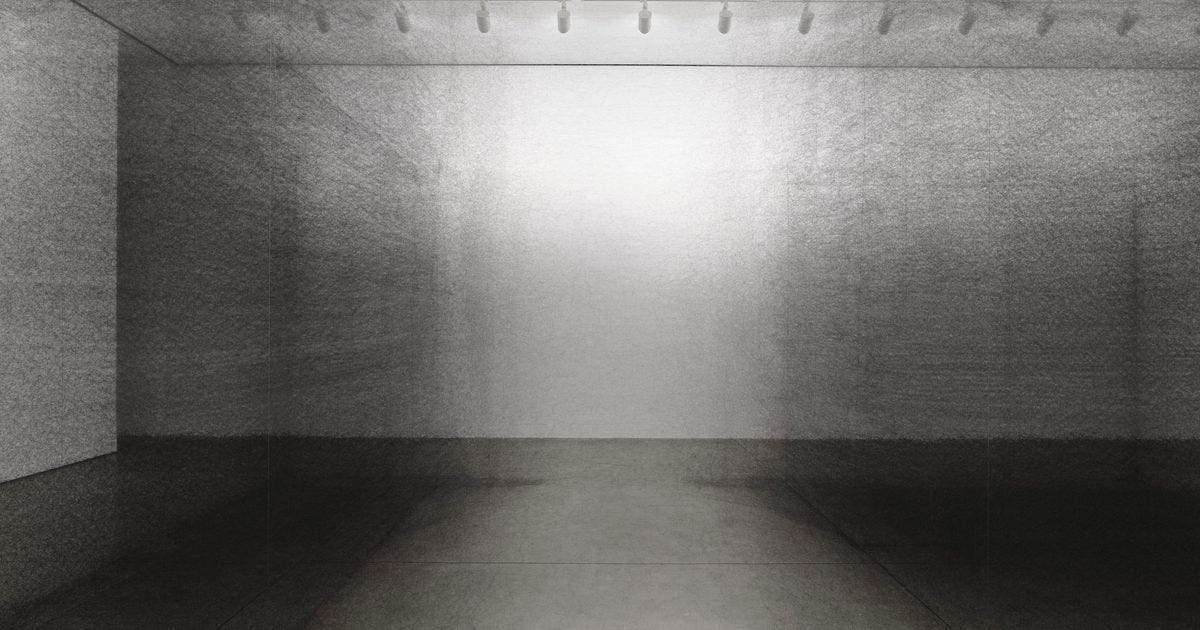
Huyssen also reports what Salcedo told the architect who has long worked with her: she wanted to make “the shadow of a non-existing house.” The photographs bear that out. From a distance the work reads as a dark, solid volume. Up close the weave turns everything behind it to haze: the gallery’s track lights glow through it, and the far wall dissolves into light. It has the outline of shelter and none of the protection.
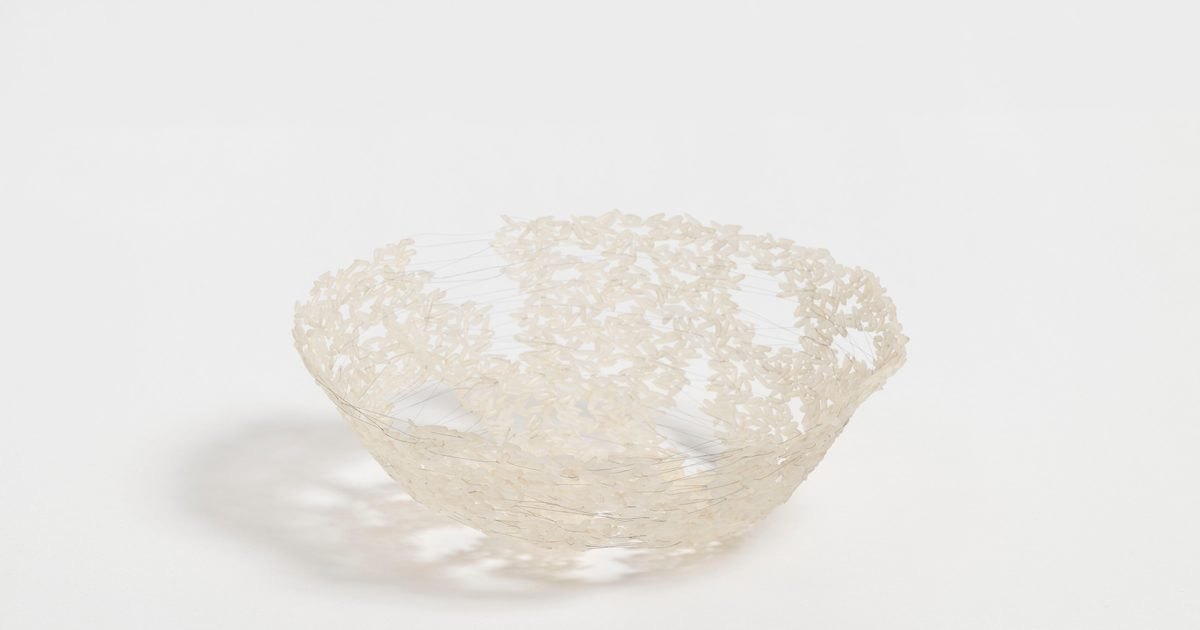
The second work is on the upper level. Grains of Sorrow (2023-26) is a group of 47 bowls made from rice and human hair and set out across the floor. The grains are bound with resin, and strands of hair run through holes drilled into individual grains, work for which the studio used special drills, W Magazine reports. The bowl pictured here is a pale lattice with gaps wide enough to see through, and it casts a shadow full of holes. None of the 47, Huyssen notes, could hold food.
Salcedo has said what the two works answer. “Losing a home is not merely losing a physical roof,” she told W Magazine. The gallery describes the exhibition as a response to “the devastation of displacement and the basic human need for home and sustenance.” Huyssen, in an essay for Doris Salcedo: Acts (an anthology), published by White Cube this year, is more exact. He names domicide, the deliberate destruction of homes, and famine brought about by political decisions, and he ties both to the wars in Gaza, Ukraine, Yemen, Myanmar, Syria and Sudan. He also points to a gap in the law: starvation used as a method of war is a crime, while the destruction of homes has not been codified as one.
Salcedo was born in Bogotá in 1958 and still lives and works there. Hair has been in her sculpture for a long time. White Cube notes that her early works used organic matter such as hair and bone along with worn fabric, and that later ones turned to found furniture and household objects. “I work with materials that are already charged with significance,” she has said. In Atrabiliarios (1992-2004), shoes sit in wall niches behind animal skin. In Shibboleth (2007), she opened a crack in the floor of the Turbine Hall at Tate Modern. Fragmentos, which opened in Bogotá in 2018, is a gallery and memorial whose metal floor tiles were cast by women who survived the conflict’s violence, from melted weapons surrendered by the FARC after the 2016 peace accord, as W Magazine describes it.
The new installation is related, the gallery says, to Uprooted (2020-22), a work made from more than 800 dead trees and shown at the 2023 Sharjah Biennial. It also follows her usual method. Each project begins with years of research, according to White Cube, and the slow labor of making is itself “an act of devotion and an attempt at restoring dignity to the victims.” Huyssen calls the result “art made politically,” as distinct from political art built on identity.
A retrospective that opened at the Museum of Contemporary Art Chicago in 2015 traveled to the Guggenheim in New York and the Pérez Art Museum Miami. Solo exhibitions followed at Glenstone in 2022 and the Fondation Beyeler in 2023, and in 2024 Salcedo received the Praemium Imperiale. This is, by W Magazine’s account, her first major solo show in New York in more than a decade.
It is a spare one: two works, two floors, one material running through both. Hair, the magazine observes, outlasts the rest of the body. Here it stands in for a roof.
On view
Doris Salcedo
White Cube New York, 1002 Madison Avenue, New York, NY 10075
November 13, 2026 to February 6, 2027
Admission is free. Capacity is limited and visitors may need to wait before entering.
The gallery’s page currently lists opening hours of Tuesday and Wednesday, 10 am to 6 pm. Confirm before visiting, particularly around Thanksgiving.
Sources: White Cube, Doris Salcedo, New York (2026) · White Cube, artist page · White Cube New York · W Magazine
Rita Lundqvist, Fables With the Ending Left Out
Rita Lundqvist, Tanya Bonakdar Gallery, New York, through December 18, 2026
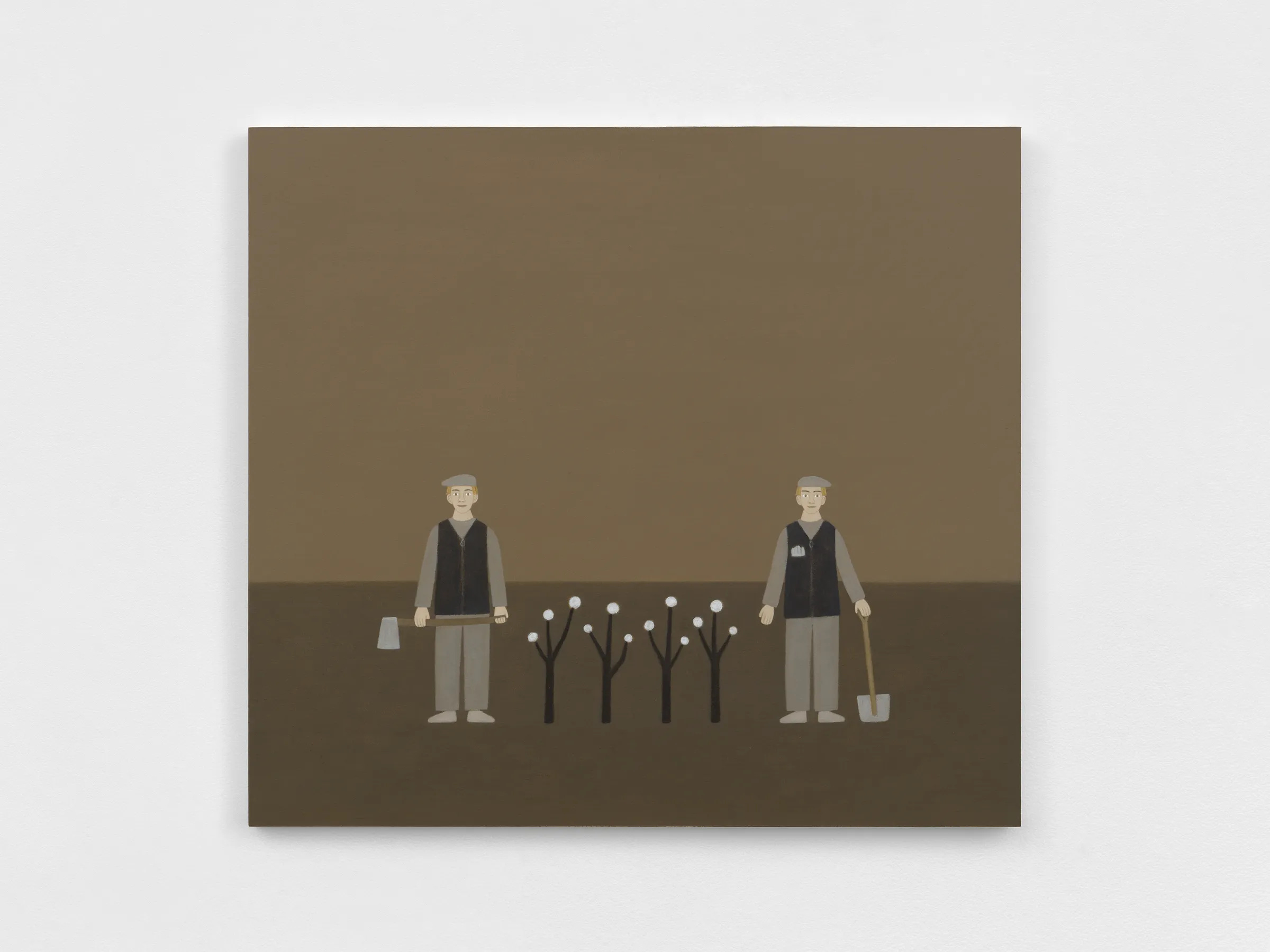
Two men face us, each the mirror of the other: flat cap, dark vest, grey shirt and trousers, bare feet. One holds an axe. The other rests a hand on a spade. Between them stand four saplings, bare except for white dots at the branch tips that read as buds. Behind everything, a single line divides the panel into a lighter brown above and a darker brown below.
That is the whole of Axe and Spade/Yxa och spade (2026), and Rita Lundqvist does not say what happens next. The trees might be about to go into the ground or about to come down. The painting holds both tools in plain view and does not choose.
Lundqvist was born in Hässleholm, Sweden, in 1953 and lives and works in Stockholm. Her exhibition at Tanya Bonakdar Gallery in New York is her fourth with the gallery and her first there in nearly ten years. The gallery’s list for the show runs to twelve paintings: ten dated 2026 and two, Mountain/Berg and Box/Låda, from 2016. The new works are oil on panel.
The rules are strict. Every composition, the gallery notes, is divided by a stark horizon line into foreground and background. The forms are flattened, and the palette stays within muted greys, indigos, pale yellows and ochres. One or two figures stand on the ground line, and each scene holds only a few things. The titles read like an inventory: Basket/Korg, Stones/Stenar, Two Birds/Två Fåglar, Three Moons/Tre Månar.
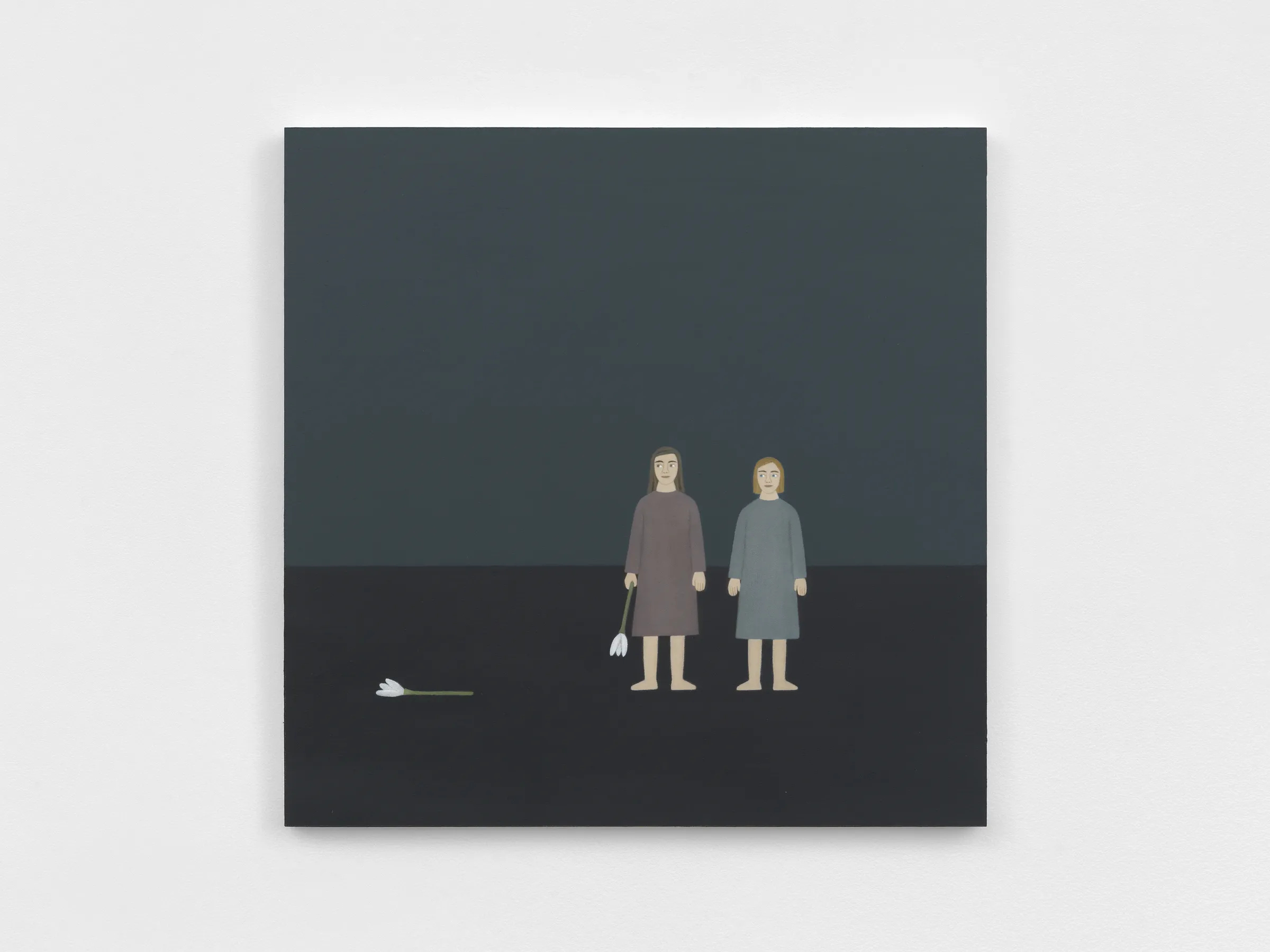
In Two Girls/Två flickor (2026), the upper field is slate blue and the lower one nearly black. Two figures in plain long-sleeved dresses, one mauve and one grey blue, stand side by side, barefoot, a little to the right of center. One holds a white flower at her side with its head pointing at the ground. The other has empty hands. Well to their left, a second white flower lies on the dark ground. The gallery describes the pair as looking at that discarded blossom. Something has happened or is about to, and the painting gives only the evidence.
The gallery offers readings, not answers. Its text compares these pared-down compositions to the structure of a fable and its moral. It suggests that the horizon may mark the divide between sky and earth, or between heaven and hell, and that the shallow, level space also resembles a stage set, where reality and fiction meet. It calls the figures surrealist and folk-inspired. What it insists on most is formal: in Lundqvist’s work, it says, “the focus is always composition and color.”
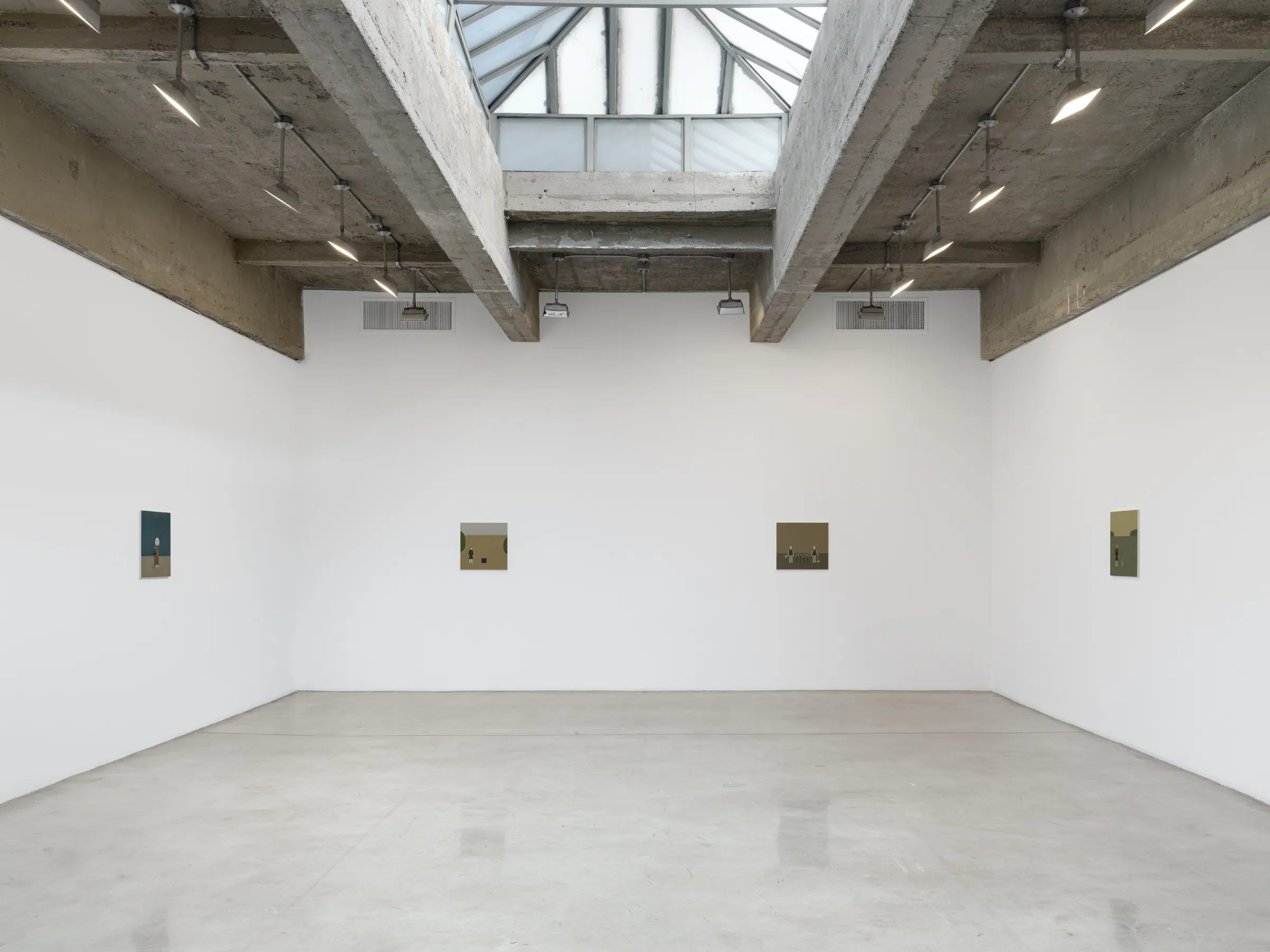
Scale is part of the effect. The gallery calls the paintings “intimately scaled,” and its installation photographs show how much empty wall surrounds each one: four small panels hung far apart in a tall white room with a concrete-beamed ceiling and a skylight.
Lundqvist studied at the Royal University College of Fine Arts in Stockholm from 1980 to 1985 and was elected to the Royal Swedish Academy of Fine Arts in 2000. She has had solo exhibitions at Norrköpings Konstmuseum (1999), Liljevalchs konsthall in Stockholm (2010) and Malmö Konsthall (2011), and in 2011 she received the Barbro & Holger Bäckström art scholarship, which the gallery describes as one of Sweden’s largest grants. Her paintings are in the collections of Moderna Museet in Stockholm, Göteborgs Konstmuseum, Malmö Konstmuseum and Borås Konstmuseum. She first showed with Tanya Bonakdar in 2002, and again in 2009 and 2017.
These pictures are quick to see and slow to finish reading. Count what is there: two men, four trees, two tools. The story is whatever those add up to.
On view
Rita Lundqvist
Tanya Bonakdar Gallery, 521 West 21st Street, New York, NY 10011
November 5 to December 18, 2026
Tuesday to Saturday, 10 am to 6 pm. Closed Thursday, November 26, for Thanksgiving.
Sources: Tanya Bonakdar Gallery, Rita Lundqvist · Tanya Bonakdar Gallery, artist page · Tanya Bonakdar Gallery, hours
Angela Heisch, Geometry Gone Soft
Soft Possession, GRIMM, London, November 25, 2026 to January 9, 2027
Angela Heisch used to work her paintings out in advance. For earlier exhibitions, her larger canvases had counterparts in small chalk pastel drawings. For Soft Possession, which opens on Wednesday at GRIMM in London, she abandoned the studies once the first layer of paint was on the canvas, the gallery says.
The gallery’s word for the result is a “softening.” Heisch, who was born in Auckland in 1989 and lives and works in New York’s Hudson Valley, makes abstractions that GRIMM has described as “geometrically precise,” built on what it calls “oppositional symmetry”: hard against soft, light against dark, flatness against depth. In new paintings such as Softcore and Ages, by the gallery’s account, radiance and fluid gestures spiral outward from a central orb, a form its text compares to a flower opening from a bud and to a star giving off light.
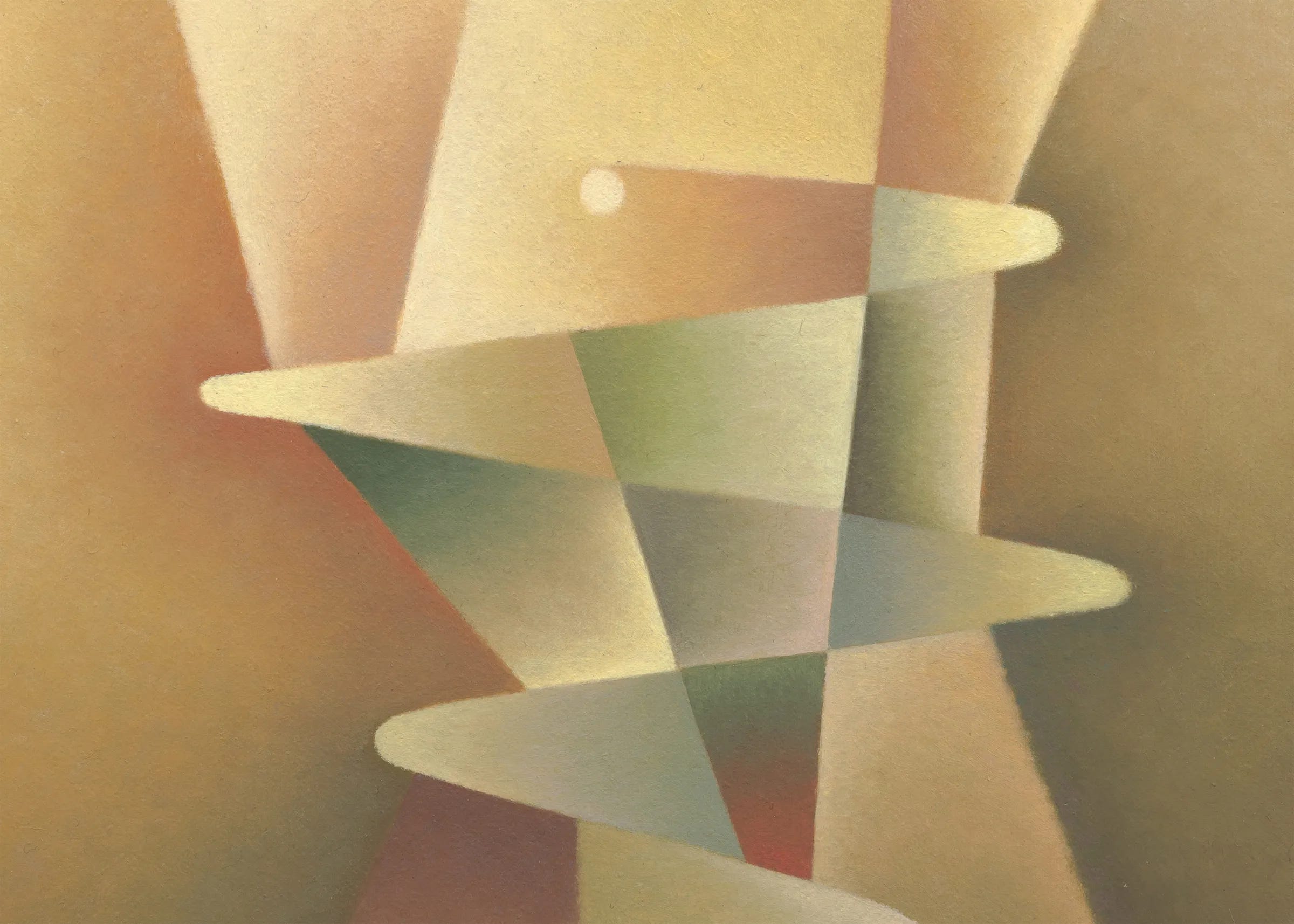
The image GRIMM has published ahead of the opening is a detail of Bundling (2026), and it shows what softening looks like at close range. A pale column of light falls from the top edge onto a stack of long, lens-shaped forms that cross a zigzag of triangular planes. The colors are warm and close in value: butter yellow, peach, ochre, sage green and grey violet, with one seam of red orange near the bottom. A small pale disc sits near the top. Every edge is feathered, so the planes seem lit from inside. Heisch paints in oil, applied in the multiple thin layers that the gallery says give the work its opalescent quality, yet the surface here reads like pastel.
Light is the subject the gallery’s text keeps returning to. In these works, it says, light no longer illuminates and “makes clear.” It expands and softens the forms. Heisch speaks of the old analogy between microcosm and macrocosm, in which the human being and the cosmos reflect one another, and she describes her paintings as “mirrors” on which associations and bodily responses dissolve into one another. The sense of growth in them, GRIMM adds, is biomorphic, and could be organic or cosmic in scale. Her titles, the gallery notes, hint at motion and atmosphere: Surgent, Skipping Stone.
Heisch studied at SUNY Potsdam (BA, 2011) and the University at Albany (MFA, 2014) and joined GRIMM in 2022. Soft Possession is her fourth exhibition with the gallery, GRIMM says, following solo shows in Amsterdam (Gilded Slides, 2022, and Chambers, 2025) and New York (As above, so below, 2023), and her first at its London space. In 2023 K11 Art Museum in Shanghai presented an exhibition also titled As above, so below, and earlier this year Gleaming Containment ran at Yi Space in Hangzhou.
London has seen her work before, in solo shows at Pippy Houldsworth Gallery in 2021 and 2023. Her paintings are in the collections of the Stedelijk Museum Amsterdam, The Whitworth in Manchester, the Institute of Contemporary Art, Miami, the Tel Aviv Museum of Art, the New Orleans Museum of Art and the Columbus Museum of Art, among others. GRIMM published a book on her work, As above, so below, in 2023, with an essay by Cassie Packard.
The question the show sets up is how far the loosening goes. If precision has been the constant in Heisch’s painting, Soft Possession tests what happens to it when the plan is dropped after the first layer.
On view
Angela Heisch: Soft Possession
GRIMM, 43a Duke Street, St James’s, London SW1Y 6DD
November 25, 2026 to January 9, 2027
Tuesday to Saturday, 11 am to 6 pm. Holiday hours have not been posted, so check with the gallery before visiting over Christmas and New Year.
Sources: GRIMM, Angela Heisch: Soft Possession · GRIMM, artist page · GRIMM, locations and hours
No feature on Artébay is paid for. If you spot an error, tell us in the comments or reply to this email, and we will correct it here with a dated note.
Discussion about this post