Artébay, November 22: Xylor Jane, Bosco Sodi
Grids that collide into portraits in Tribeca, and copper paintings left to turn green in Chelsea.

Xylor Jane, Grids That Collide
Paintings for People, CANADA, New York, through December 19, 2026
For most of her career, Xylor Jane built her paintings out of dots. Thousands of them, set down one at a time, formed grids of numerals and patterns drawn from mathematics, with titles like 10th Order Magic Square for Planet Earth (2019) and Days Alive (2019). Some of the paintings counted out her own imagined lifespan, which she mapped, according to her gallery, often down to the second.
Then she stopped. CANADA, which is showing her new paintings in Tribeca, gives the reasons in plain physical terms. Years of painting tiny dots through high-powered magnifying glasses gave her vertigo. She had also run out of the numbers she wanted to paint, something she never expected to live long enough to see, though the gallery points to her notebooks of long numbers, dog-eared from use, as a measure of how far she went. Paintings for People is what came after: work made without the old safety net of calendars and counting.
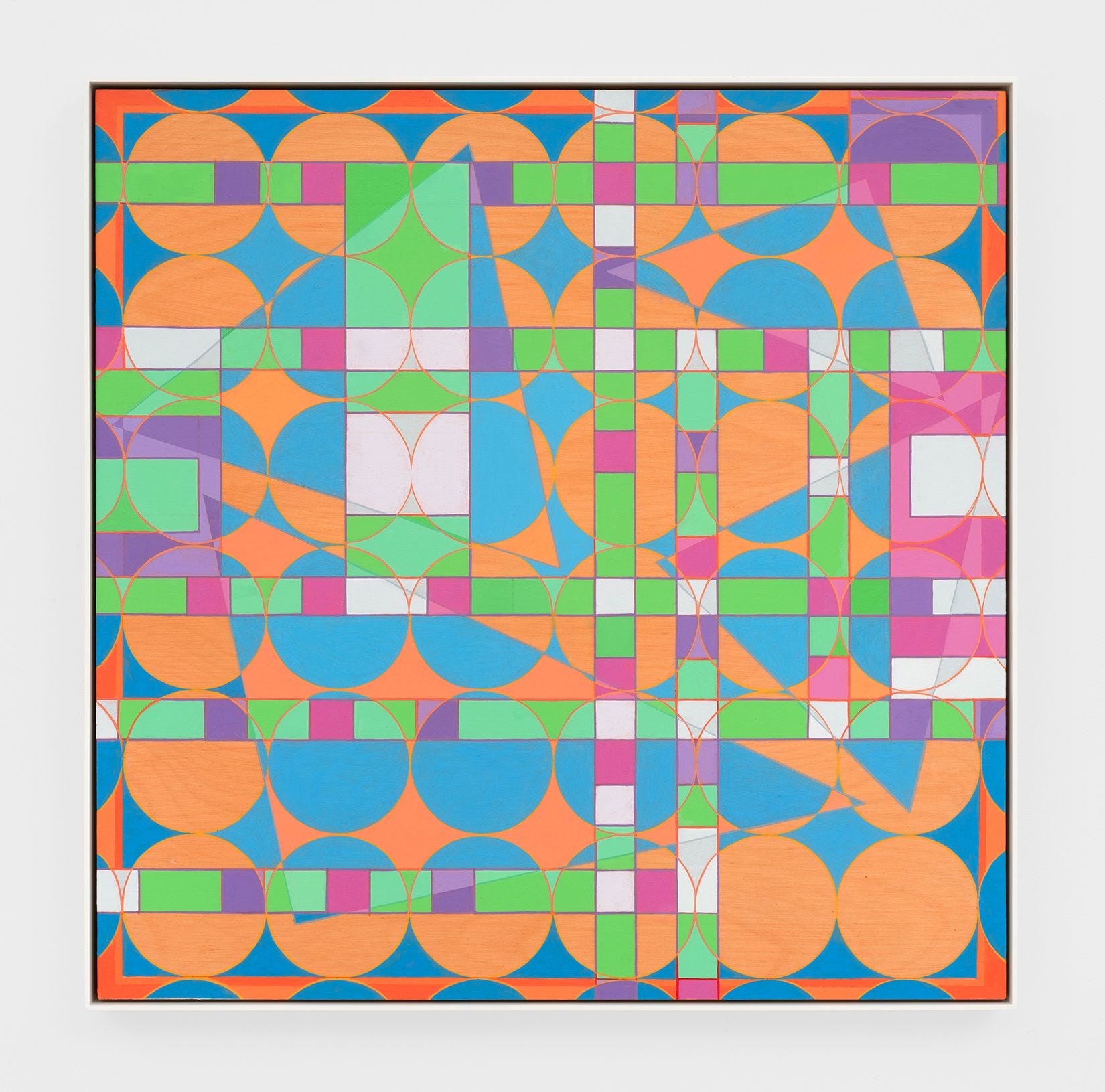
The new paintings run several grids at once and let them collide. John Jack (2026) is the clearest case. The gallery says it quotes a 22-inch square passage of Piet Mondrian’s Broadway Boogie Woogie, overlaid with a second grid of circles and closed in by an ornamented border. The painting itself is 22 inches square, the same size as the passage it borrows. In the photograph, orange circles sit on a blue ground, cut by bands of small green, pink, violet and white blocks. Pale, translucent wedges wash out parts of the pattern. Those, according to CANADA, are scotomas, blind spots: a visual effect Jane sometimes experiences and has set out to paint. Her own term for what she is after is “eye feel.”
The colors carry the show’s title. Each palette, the gallery says, is chosen as a homage to a particular person in Jane’s life, based on the colors she sees that person embodying, which makes every painting a kind of portrait without a face. The titles keep their subjects private: Lucky Se7ens, Double Nine, Cravat, Unbroken, Bambi Lake, and S.O. (Symphyotrichum Oolentangiense) Aster, named for a wildflower.
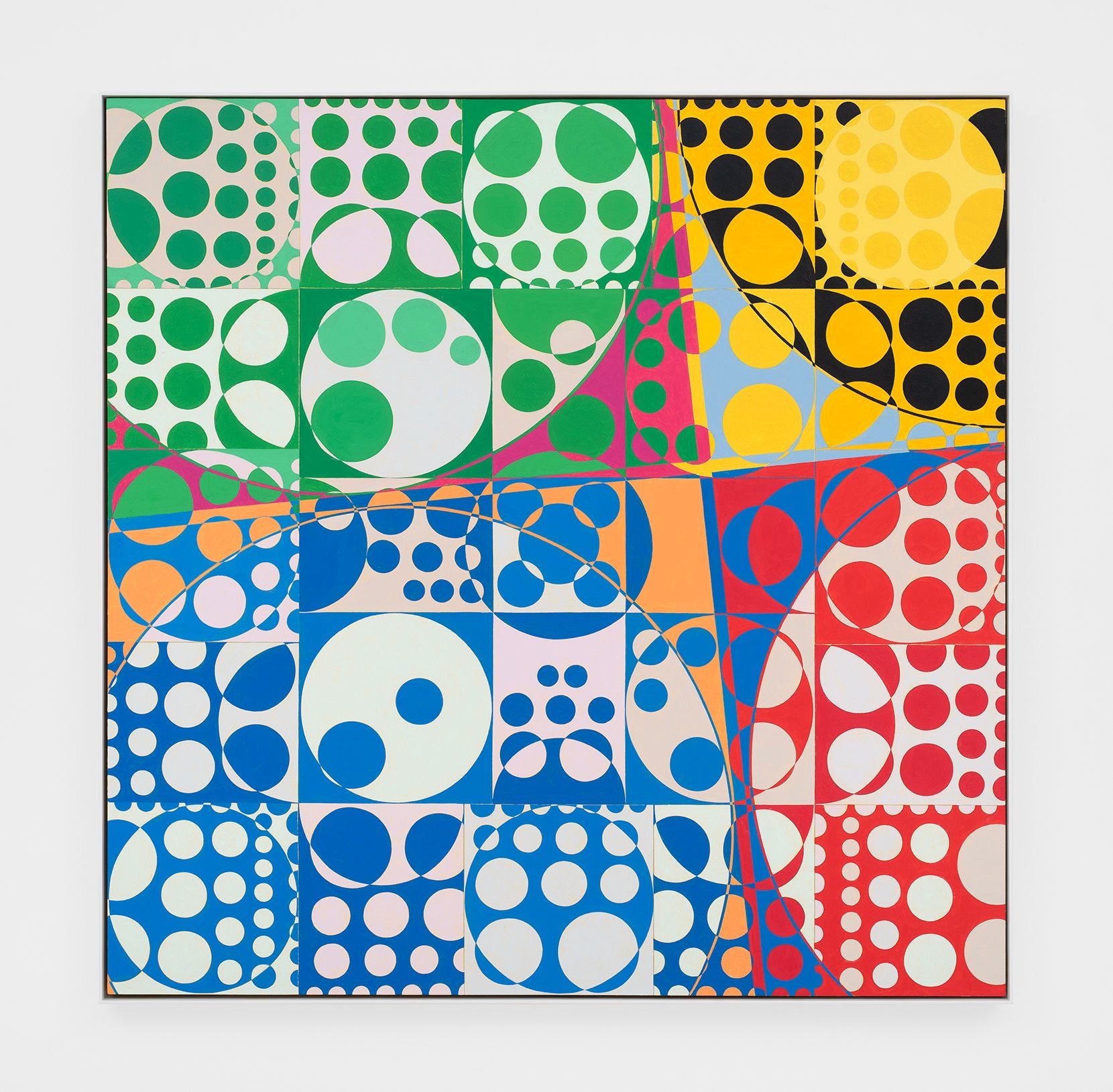
Lucky Se7ens (2026), at 33 inches square, shows how the collisions work on a larger panel. It splits into four zones: green at upper left, yellow and black at upper right, blue and red below. Each zone is a checkerboard of squares filled with circles and dots of different sizes. Great arcs sweep in from the corners and overlap near the center, and where they cross, slivers of pink, pale blue and orange appear that belong to neither system. The gallery describes moments like these, where the grids overlap, as the places where small fractals bloom, and credits them to the attention of Jane’s hand rather than to any plan.
CANADA’s text reaches back to Albrecht Dürer’s engraving Melencolia I (1514), in which a winged figure sits among a geometer’s tools, beside a grid of magic numbers, staring at a large geometric solid. In the European humanist tradition, the gallery notes, melancholy was tied to geometry. Jane’s earlier paintings fit that lineage almost too neatly; they counted down a life. The new ones keep the geometry and drop the countdown.
Jane was born in Long Beach, California, in 1963, earned her BFA at the San Francisco Art Institute in 1993, and lives and works in Greenfield, Massachusetts. Her history with CANADA, an artist-run gallery founded in 1999, goes back to 2004, and this is the eighth solo show there listed in her CV. Roberta Smith reviewed her 2006 and 2009 exhibitions at the gallery for The New York Times, and the painter Nicole Eisenman included her in Artforum’s best of 2019. She has had solo exhibitions at the Berkeley Art Museum and Pacific Film Archive, the University Museum of Contemporary Art in Amherst and the Santa Monica Museum of Art, and with Konrad Fischer Galerie in Berlin and Düsseldorf, Almine Rech and Campoli Presti in Paris, and Parrasch Heijnen in Los Angeles.
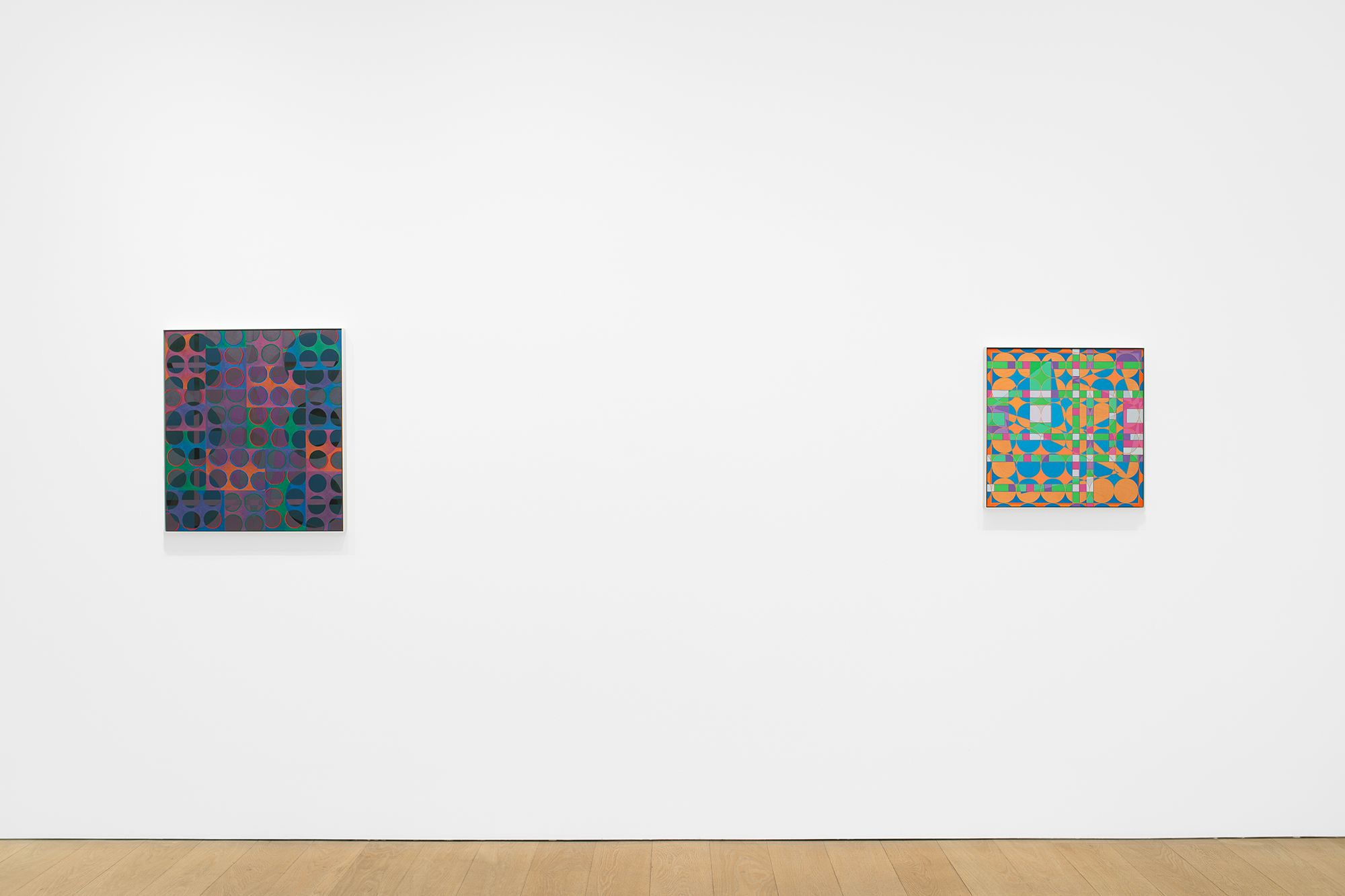
The installation view above shows two paintings hung far apart on a long white wall, each small enough to need walking up to. That distance suits them. From across the room they read as bright, orderly patterns. Up close, the order starts to slip, and that is where the paintings seem to want you.
On view
Xylor Jane: Paintings for People
CANADA, 60 Lispenard Street, New York, NY 10013
November 4 to December 19, 2026
Tuesday to Saturday, 10 am to 6 pm. Holiday hours have not been posted, so check with the gallery before visiting during Thanksgiving week.
Sources: CANADA, Xylor Jane: Paintings for People · CANADA, artist page and CV
Bosco Sodi, Paintings Left to Turn Green
Verdigris, Olney Gleason, New York, through December 19, 2026
Most painters choose their colors. In Verdigris, at Olney Gleason in Chelsea, Bosco Sodi sets up a chemical reaction and lets it decide a good part of the color for him.
The method, as the gallery describes it, starts with copper. Sodi layers copper paint and a copper-based gold powder onto canvas, then applies vinegar, salt and various acids. The metal oxidizes and turns the blue-green of verdigris, the patina of old copper roofs and statues. He varies the pressure and the humidity as he applies these agents, so the final color and texture are partly left to chance. Then he works back over the corroded surface in red, orange, white and other pigments. The paintings were made over the past year in his studio in Brooklyn.
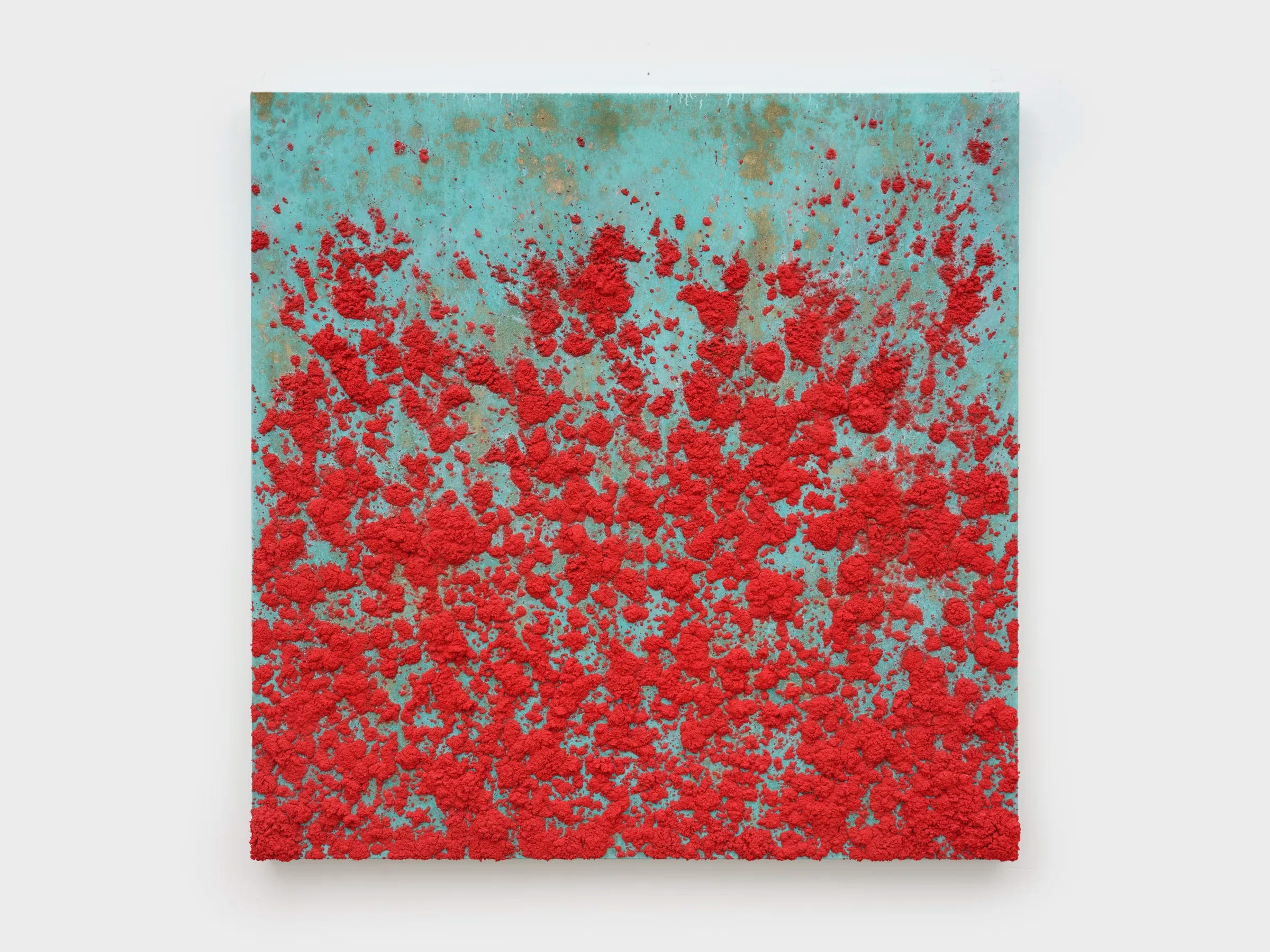
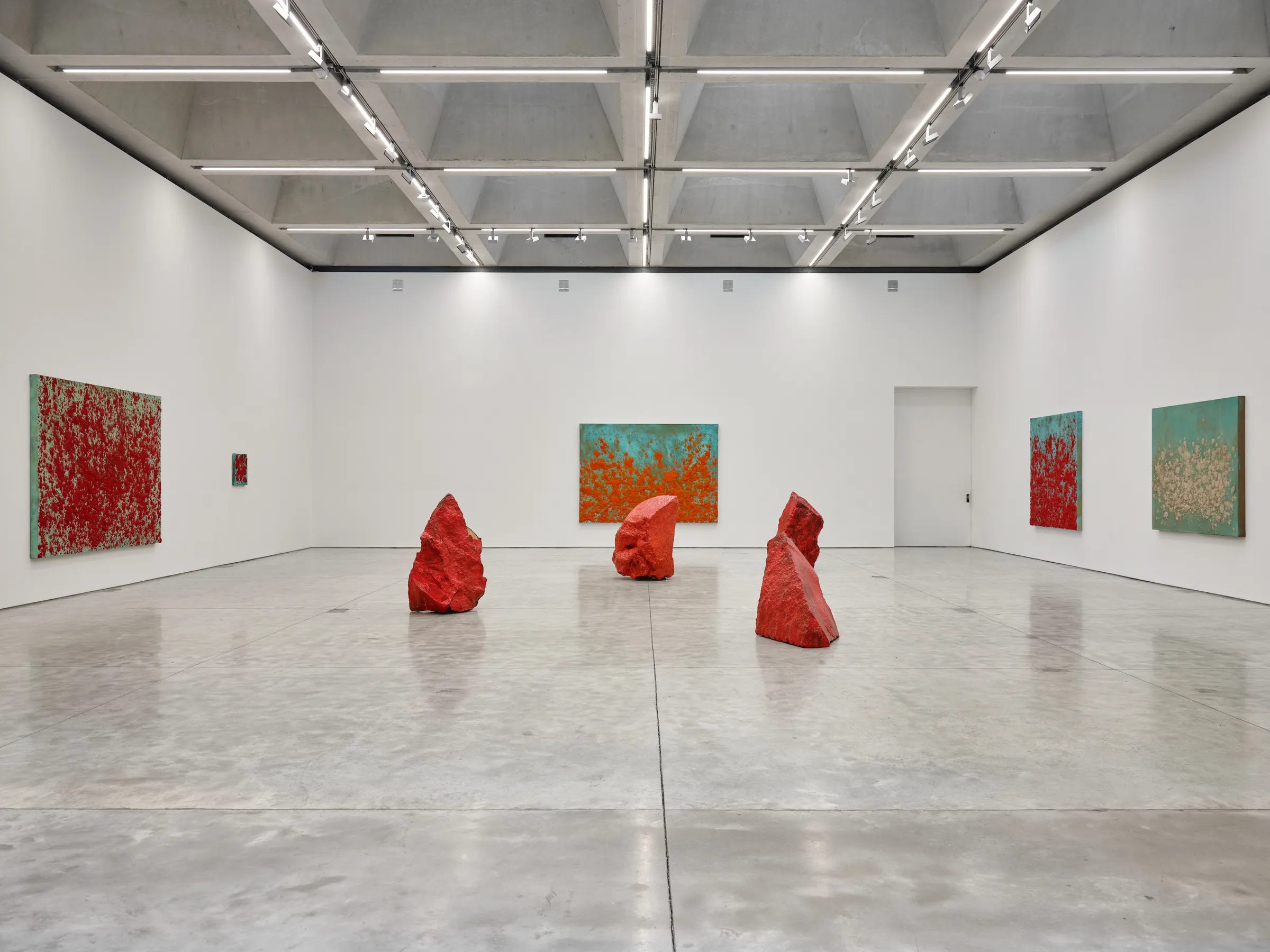
The canvas above is about six feet square. Its upper part is turquoise, stained in places with patches of rust brown where the copper reacted differently. Over it, thick clots of bright red are massed along the bottom edge and thin out as they rise, like a spray caught in midair. The red sits on the surface in heavy, raised clusters, so the painting reads almost as a relief.
The gallery presents the series as a nod to Andy Warhol’s Oxidation Paintings of 1977 and 1978. Warhol made his by urinating on canvases coated with copper paint; Sodi sticks to vinegar and salt. The gallery also places the work in a longer history of verdigris. Renaissance painters used verdigris pigments for their emerald and turquoise greens and accepted that the colors would change over time. The same patina covers the dome of the Palais Garnier in Paris and the Statue of Liberty, which, the gallery notes, Sodi can see from his Brooklyn studio.
Sodi has his own reasons for the metal. “Like clay, copper has been with us since the dawn of humanity,” he says in the gallery’s text, and he describes it as a material many believe purifies and protects, one that in Buddhism serves as a vessel for knowledge. What draws him, the gallery says, is copper’s ability to conduct energy and to make something beautiful out of deterioration.
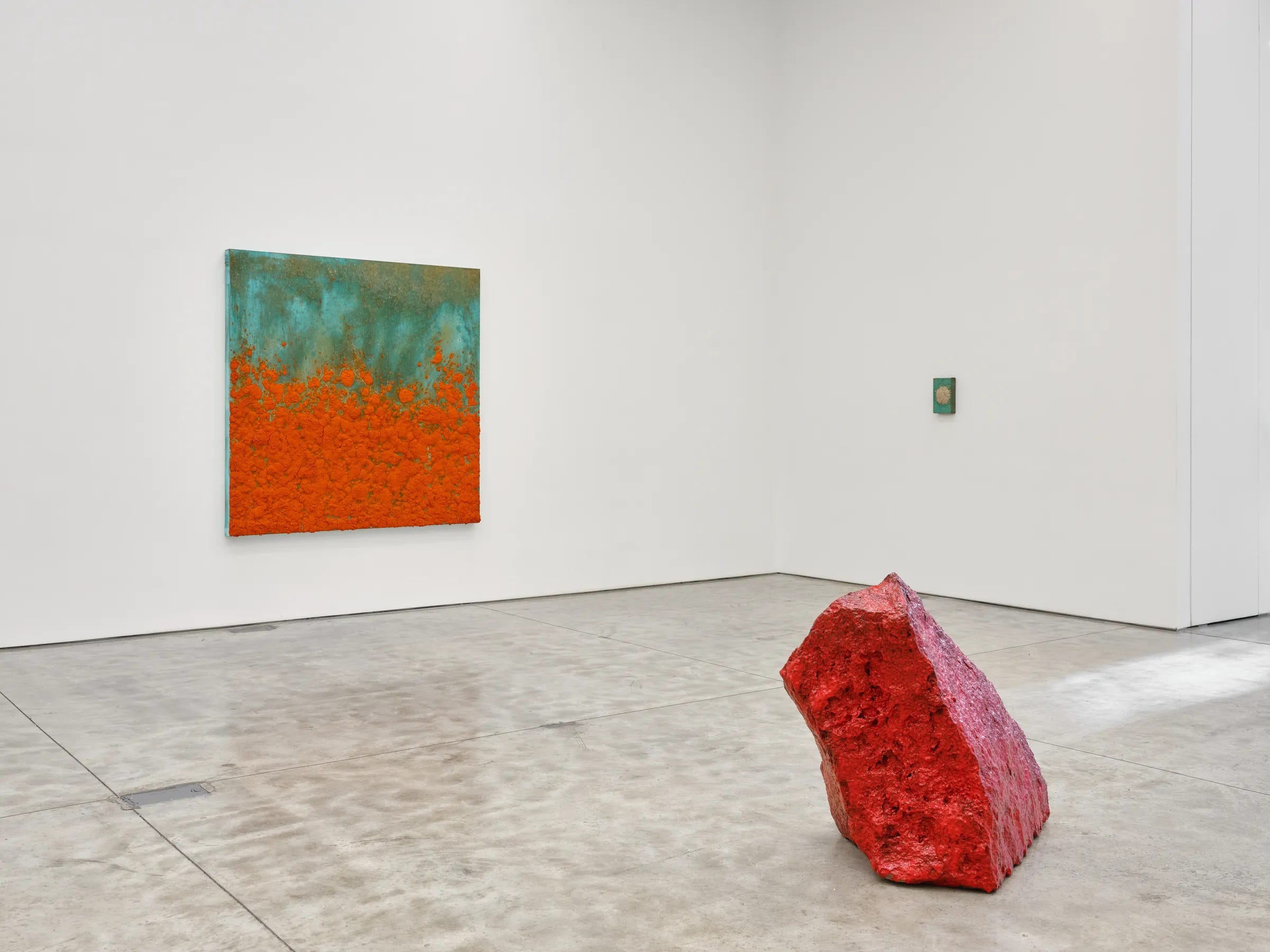
The paintings share the floor with sculpture. Sodi sources dried volcanic magma from the Ceboruco volcano in Mexico, glazes each piece and fires it for three days at high temperatures, which changes its final color and texture. At Olney Gleason the rocks come out a deep, glossy red and stand on the polished concrete like a small group of standing stones. They relate, the gallery says, to a group finished in gold. This fall, according to Axel Vervoordt Gallery, which also shows his work, Sodi presented Gold Rain, more than 400 volcanic stone sculptures finished with 22-karat gold, in the Casa Wabi Pavilion at the historic House of Lee Jang-Woo during the 16th Gwangju Biennale in South Korea.
Sodi was born in Mexico City in 1970. He is best known for large, heavily textured paintings built from raw materials, which Galerie magazine describes as layers of sawdust, raw pigment, wood pulp, fibers, water and glue, and for solid clay spheres, cubes and bricks fired in outdoor wood kilns. Imperfection and impermanence run through all of it, and Galerie connects the work to the Japanese idea of wabi-sabi. In 2013 he founded Fundación Casa Wabi near Puerto Escondido in Oaxaca, an arts center built around exchange between international contemporary artists and local communities.
His recent solo exhibitions include shows at the He Art Museum in China (2024), Harvard Art Museums (2023), Palazzo Vendramin Grimani in Venice (2022) and the Dallas Museum of Art (2021). His work is in the collections of the Walker Art Center, The Phillips Collection, the Nasher Sculpture Center, the Dallas Museum of Art, Harvard Art Museums, the Wadsworth Atheneum, the National Gallery of Victoria in Melbourne and the Jumex collection in Mexico City. The Brooklyn Rail interviewed him for its November issue and celebrated the issue’s launch at the gallery.
Verdigris is usually what happens to copper when nobody is looking after it. Sodi turns that neglect into a method, and then answers it in red and orange.
On view
Bosco Sodi: Verdigris
Olney Gleason, 509 West 27th Street, New York, NY 10001
October 29 to December 19, 2026
Tuesday to Saturday, 10 am to 6 pm. Holiday hours have not been posted, so check with the gallery before visiting during Thanksgiving week.
Sources: Olney Gleason, Bosco Sodi: Verdigris · Olney Gleason, Untitled, 2026 · Axel Vervoordt Gallery, Bosco Sodi at Gwangju Biennale · Galerie, 8 Must-See Solo Gallery Shows in November
No feature on Artébay is paid for. If you spot an error, tell us in the comments or reply to this email, and we will correct it here with a dated note.
Discussion about this post